I was a little taken aback when my nephew, who was born and raised in Maryland, chose to study Spanish in high school. As a first-generation American born to African parents, it struck me as an interesting choice, since many Africans have traditionally gravitated toward learning French as a second language. Yet French was not even on his radar. Given that we live in a metropolitan area with a large Spanish-speaking population, I assumed his decision was simply a practical one.
It was only when my niece—who had grown up in Malawi—moved to the United States and also chose to study Spanish that I paused to reflect more deeply on this trend. While Spanish is not commonly taught in Malawi, she attended the African Bible College (ABC), an American school, which I thought may have exposed her to the language and influenced her decision. Her experience, however, reflects a broader shift taking place across Africa in recent years: the growing presence, popularity, and influence of the Spanish language.
Spain’s colonial presence in Africa was smaller than that of other European powers, such as Britain and France. However, Spain maintained a foothold on the continent through several territories, including Equatorial Guinea; parts of Morocco, such as the Northern Zone and Ifni; and Western Sahara (then known as Spanish Sahara), a non-self-governing territory bordering present-day Morocco.
Spain’s presence in Africa also includes the Canary Islands and the cities of Ceuta and Melilla, which remain under Spanish sovereignty today. Although Ceuta and Melilla are geographically located in Africa, both cities are politically part of Spain and, therefore, part of the European Union. As a result, they serve as important points of contact and exchange between Europe and Africa. However, much of Spain’s contemporary linguistic and cultural presence on the continent is centered in Equatorial Guinea, the only Spanish-speaking country in Africa. Despite its relatively limited colonial footprint, Spain left a lasting cultural, linguistic, and political legacy in several parts of the continent.
Today, Spain’s engagement with Africa is expanding in wider parts of Africa through cultural institutions, diplomatic initiatives, educational programs, and economic partnerships. The Cervantes Institute and Casa África released new data highlighting the reach of Spanish influence in Africa in their book, Spanish in sub-Saharan Africa. According to the book, around 3.5 million people currently study the Spanish language in sub-Saharan Africa. This includes Africans in countries such as Senegal, Cape Verde, Madagascar, and more surprisingly, even French speaking countries such as Ivory Coast, Benin, Senegal, Cameroon, Gabon, Togo, and the Central African Republic.
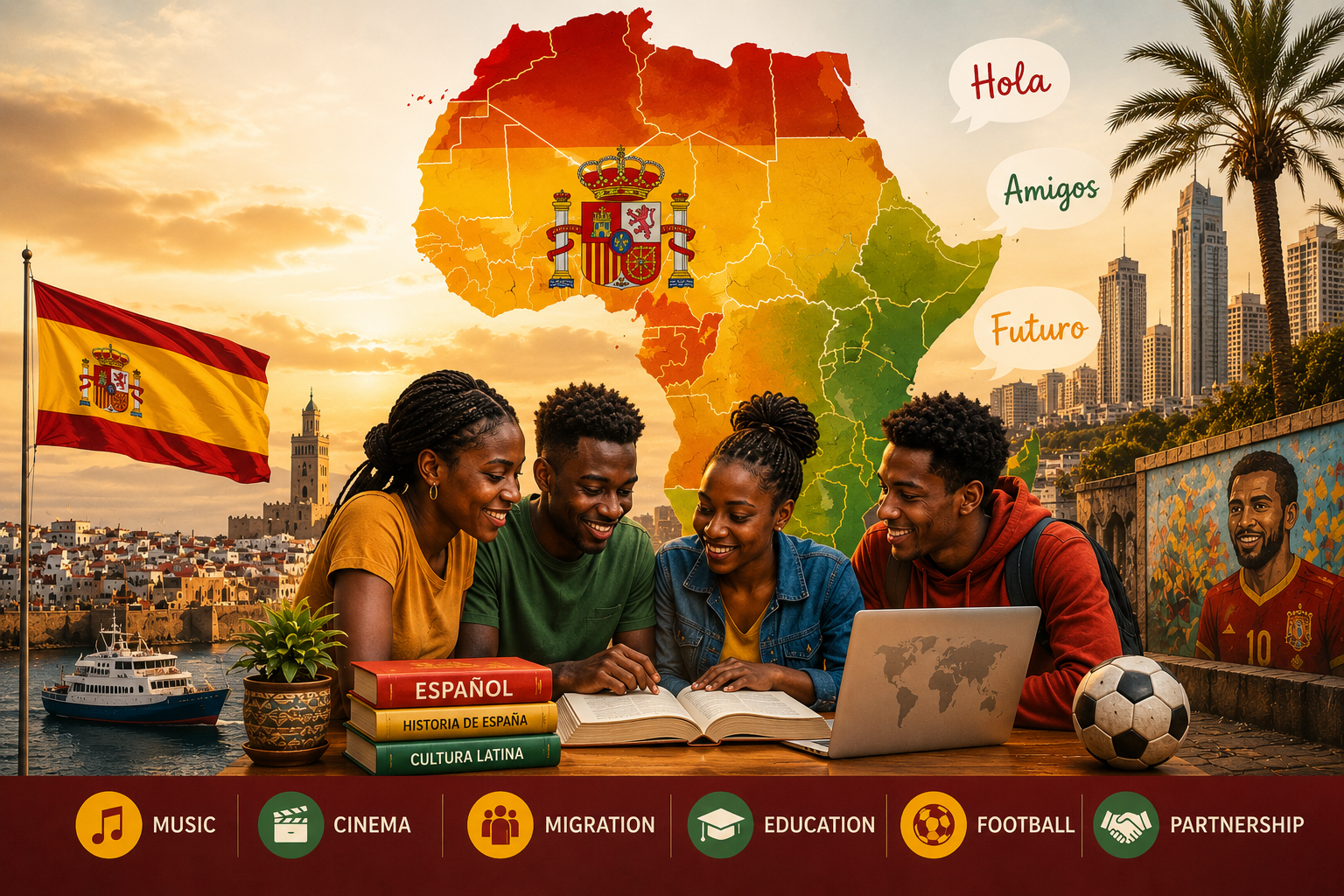
The number of Africans learning and speaking Spanish has doubled in recent years. Researchers attribute the growing popularity of Spanish to several factors, including the global appeal of Latin music, film, and migration. The popularity of global football has also played a role in fostering interest in the Spanish language. Spanish football clubs such as Real Madrid and FC Barcelona enjoy enormous followings across Africa, exposing millions of fans to Spanish language and culture through sports media and fan communities. Many young Africans are also able to see themselves reflected in the ethnic and cultural diversity of these teams, which may further strengthen their affinity for the language. One notable development is the 2030 FIFA World Cup, which will be jointly hosted by Spain, Morocco, and Portugal on the competitions 100-year anniversary. This partnership reflects Morocco’s rising influence in global football and Spain’s long-established football presence on the international stage. More broadly, it highlights how Spain and Morocco are positioning themselves as important bridges between Europe and Africa.
Another factor is the declining prestige of French in parts of Africa. In recent years, France has faced increasing criticism for what many regard as neo-colonial relationships with its former colonies, particularly its continued economic influence in the region through mechanisms such as the CFA franc. These tensions have contributed to growing anti-French sentiment in several countries, in West and Central Africa. In countries such as Burkina Faso, Mali, and Niger, governments have called for the withdrawal of French military forces, reflecting broader efforts to reduce French influence in the region.
The growing popularity of Spanish in Africa reflects shifting cultural, economic, and political relationships that are reshaping the continent’s connections to the wider world. While French and English continue to dominate many educational and official spaces, the rise of Spanish points to the emergence of new centers of influence and new opportunities for engagement.
My nephew’s decision to study Spanish no longer seems as novel as it once did to me. Nor does my niece’s choice. Whether through music, migration, education, sports, or diplomacy, the language is finding new audiences and new relevance. The growing presence of Spanish in Africa reminds us that cultural influence is never fixed and that Africa’s relationships with the world continues to diversify.